

Download the net worth tracking spreadsheet:
Getting Organized
We’re going to take it slow in these first few lessons. Before we start busting out some fancy moves, I just want to make sure that you’re on solid footing.
Managing your own money can seem overwhelming at first, but being organized, creating a plan, and then having the discipline to follow through on that plan is all it takes.
Housekeeping item #1: let’s get organized. Start a folder on your computer for all things personal finance. I’ve got mine in Documents –> Personal Finance.
Throughout this course, I’ll be introducing you to numerous spreadsheets to automate the number crunching part of things. Keeping everything in one master folder will help you to stay on top of everything.
In my own folder, I’ve also create sub-folders for bank statements, investment trade confirmations, tax returns, and all of the other random financial documents that always seem to pop up. If it relates to my money, it’s saved there.
It’s a boring first step, but will come very much in handy later on. Come tax time, you don’t want to be digging through old computers, paper files, and calling the bank. Trust me, it’s not fun…
Calculating Your Net Worth
Housekeeping item #2: find out what your financial picture looks like today by calculating your net worth.
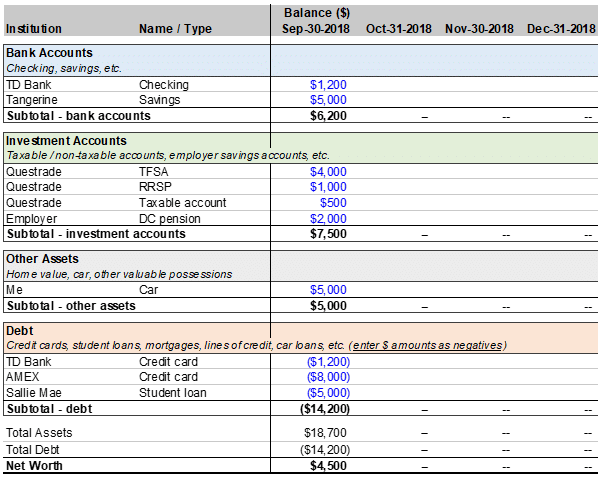
The goal is to create something similar to the example shown below…
If you’d like to use this spreadsheet template:
- To use this in excel, download the file and you’ll be able to open with excel (recommended option)
- If you’d prefer using Google Sheets, open it in google sheets and then click file -> make a copy, and then save on your own Google drive account (you need to be logged in to your Google account to do this)
Feel free to adjust the dates at the top as you wish (e.g., to put in today’s date), add rows for new accounts, and add columns for new time periods.
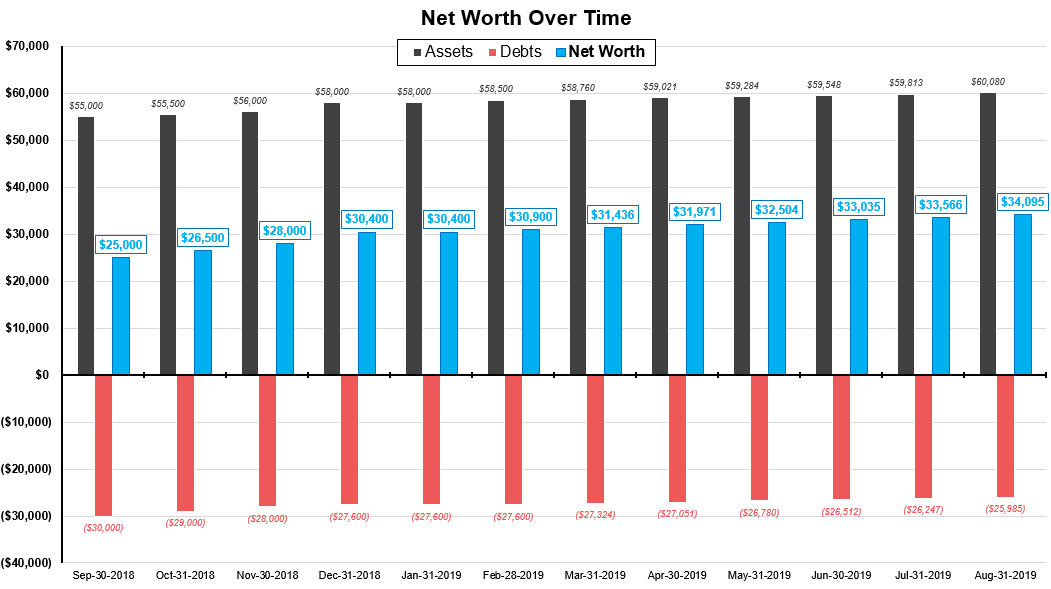
This spreadsheet template will also automatically generate a chart so that you can visualize your net worth progress.
If you’d rather use pen and paper for this, that works too.
Walking Through the Steps
Start by making a list of all of the bank accounts and investment accounts that you have. Anywhere that you receive money, hold money, have money invested, etc.
Jot down that list, together with the current balance of each of the accounts.
Next, add a section for the estimated value of your major possessions. Don’t go overboard with this — you don’t need to include your tupperware and gym shoes. Your home (if you own it), your car, and other valuables will do.
The sum of your bank accounts, investment accounts, and your possessions is known as your total assets.
Now for the more painful part. Make a list of all of your debts. Credit card, student loan, mortgage, car loan, medical bills, money you owe to your parents, lay it all out there. The sum of these numbers is your total debt.
Finally, your net worth is calculated as your total assets minus your total debt. In the example above, this person has total assets of $18,700, total debts of $14,200, and a net worth of $4,500 (as of September 30th, 2018).
What you’ve got in front of you is a snapshot of your financial health as of today. At a glance you can see what you own, what you owe, and the net result.
If what you see is slightly shocking, don’t panic! As you work through this course you’ll learn how to get your budget under control, reduce your debt, and invest to create wealth. Onward and upwards.
Your Assignment
- Decide on a regular frequency at which you’ll update your net worth calculation (monthly? quarterly?), whatever you’re comfortable with — I personally do this at the end of every month
- Each time you sit down to do this, use a new column to jot down the current value of each of your assets & debts. Make sure you add in new rows for any new accounts that you’ve opened since the last time you reviewed your numbers
- Stick to it …forever 🙂
Once you get into the habit, this becomes quick and painless. At the end of every month, I take about 10 minutes to log in and out of various accounts and record the current balances.
Make a habit of tracking your net worth regularly. In time this’ll become like clockwork, and dare I say fun(!?) when you see yourself chugging along in the right direction.
What gets measured gets done.
Additional Resources (Optional)
We’re going to use spreadsheets quite a bit in this course. Spreadsheets are hands down the best way to keep track of your money.
You can customize things just as you need them, your financial data won’t be shared with 3rd parties, and you can centralize everything in one place. Creating pretty charts is another nice upside.
If you don’t have much experience using spreadsheets, or just want to brush up, check out this beginner’s guide to excel, and guide to Google sheets (whichever you prefer).